Marketing Strategy · Updated November 14, 2026
Waterfall Release Strategy: Real Examples and Setup
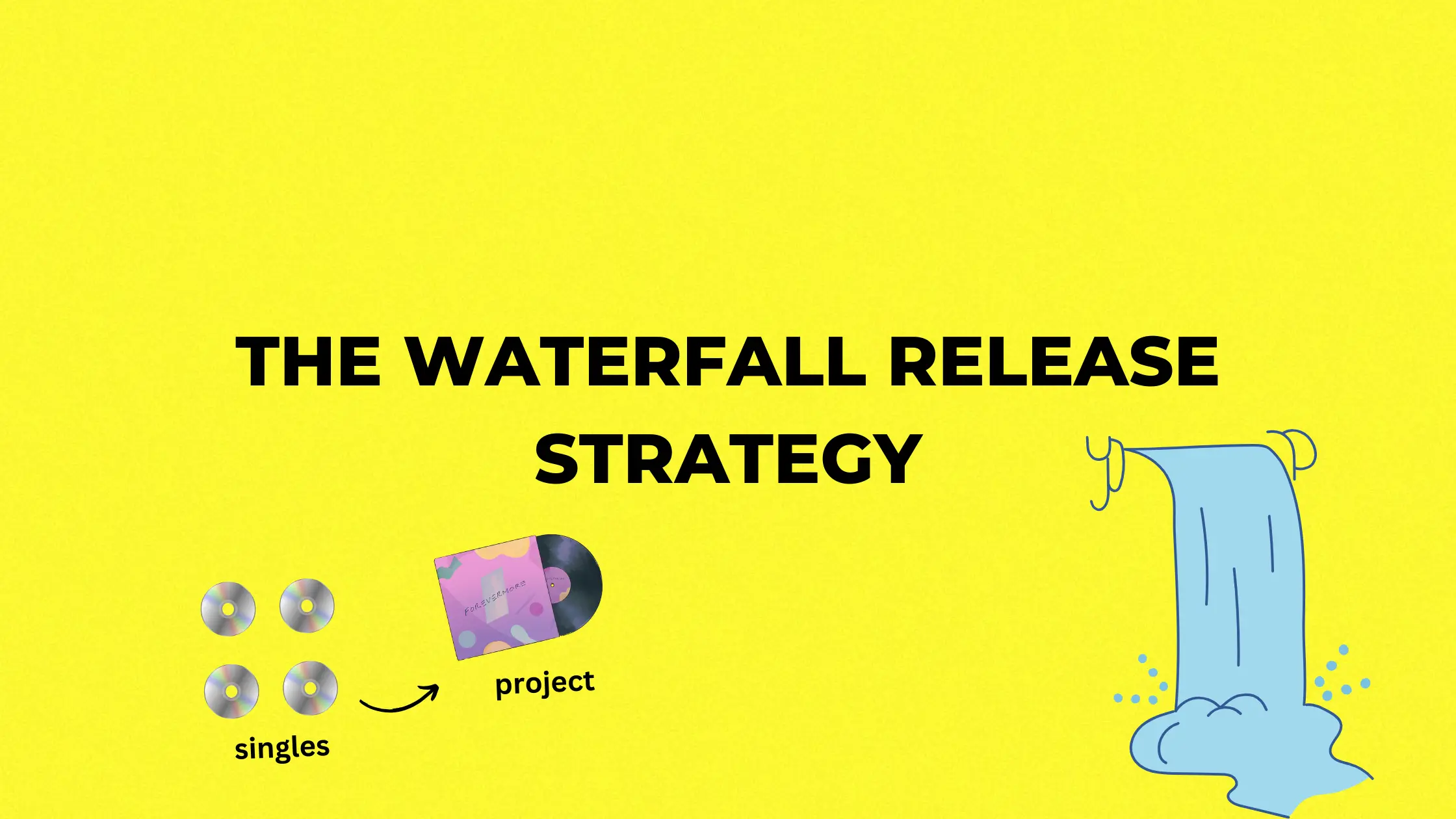
There is one release strategy the smartest major labels and independent artists keep coming back to: the waterfall release.
I used this strategy for years with my Billboard-charting band, Dwellings, because it does something a normal album drop usually cannot do. It gives each song its own moment.
The goal is not to trick Spotify. The goal is to build a release system where every single teaches you something, reaches new people, and carries momentum into the next track.
Quick answer: release the first single, include it beneath the new song on the next release, and repeat toward the full project. Keep the recording details consistent and give each new song its own promotion plan. Four to six weeks is a planning starting point, not a platform requirement.
What Is the Waterfall Release Strategy?
A waterfall release strategy rolls out songs in stages, carrying earlier singles into later releases before the full EP or album. The simplest version is one track, then a two-track single containing the new song and the first song.
Instead of one big release day, you create multiple release days. Each song gets its own Spotify pitch, content plan, smart link, email/social push, and ad test. By the time the full project drops, fans already know part of the record.
If you need the wider campaign map, start with the full music release strategy guide. If you are still deciding how to promote each single, use the music promotion guide to choose content, playlist, ad, and fan-channel priorities.
A Real Waterfall Release Example: LORE
Here is what that looks like on Spotify with LORE. The first release, Senpai, came out on August 26, 2025 with one track. The next single, Starseeker, came out on September 23 with two tracks: the new song first, followed by Senpai.
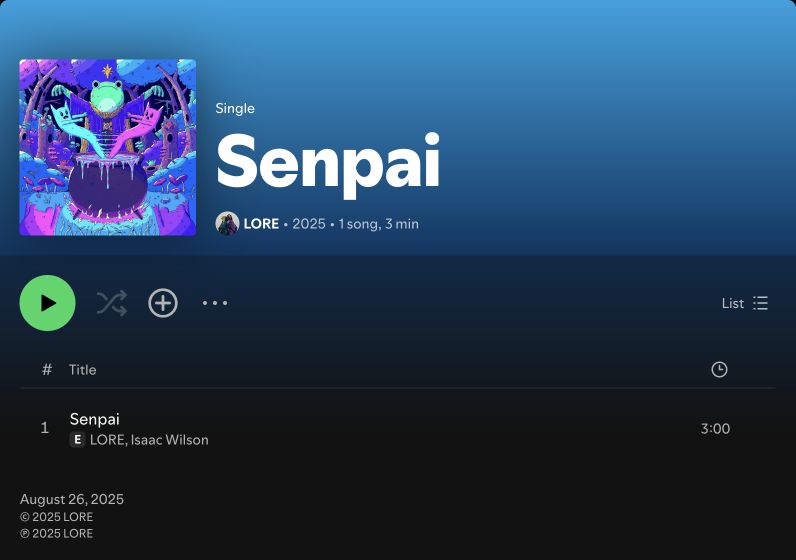
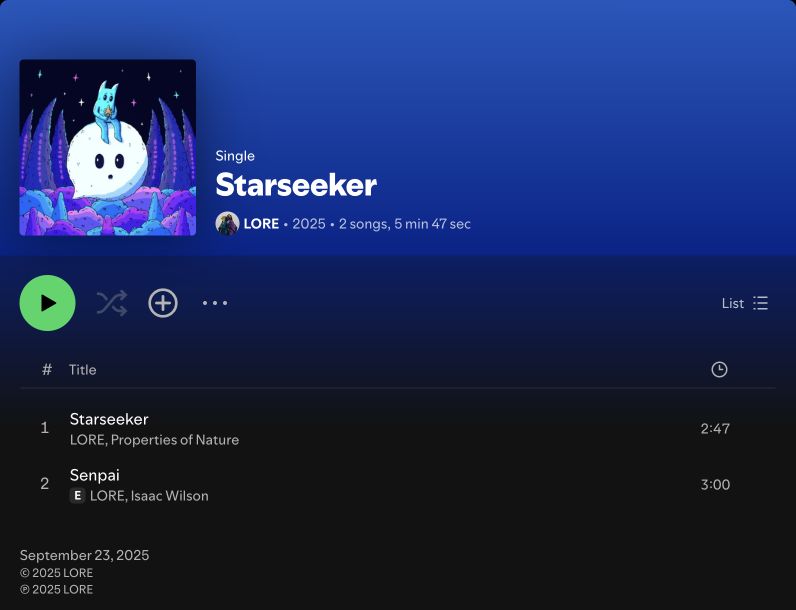
| Release | Date | What a listener sees |
|---|---|---|
| Senpai | August 26, 2025 | One song: Senpai. |
| Starseeker | September 23, 2025 | Two songs: Starseeker, then Senpai. |
| Prologue | October 3, 2025 | Five-song EP containing both earlier singles, plus Bolado, Santa Cruz Blues, and Nightwere Club. |
The first two releases were four weeks apart. The EP followed ten days later. Those are the actual dates, not a universal schedule to copy. The screenshots demonstrate the packaging; they don't establish how many streams the waterfall itself caused.
What We Did Around the LORE Release
In my LORE course, I walk through the work around the upload. We introduced the project with an animated teaser, reused material from the music video, then tested singer performance clips, behind-the-scenes content, and a guitar playthrough. On release day, the song, video, links, and pinned post needed to point people to the same release.
After release day, we kept testing hooks and different parts of the song. Comments, saves, shares, and listening gave us something to evaluate before deciding what to post next. That is the part to carry into a waterfall: each new single needs its own reason for someone to stop and listen.
Another Example: Good Terms
I also explain the approach with my client Good Terms in this simpl. waterfall walkthrough. At about 1:18, I show the sequence from Drive-In to Old Friend, with the earlier single included on the newer release. The video illustrates the release structure; use the current distributor instructions below for today's upload workflow.
Waterfall Release Strategy Setup Checklist
Set up the campaign before the first upload. Your distributor handles delivery; you still need the dates, metadata, content, links, and measurement plan.
| Item | Decision to make before release | Why it matters |
|---|---|---|
| Release dates | Choose 4-6 weeks between singles unless your content engine can support a faster pace. | Each song needs time for pitching, content, ads, and learning. |
| ISRCs | Track the ISRC for every single and reuse the right ISRC on the final EP or album. | Clean metadata helps platforms connect the recording. |
| Spotify pitch | Submit each eligible unreleased single through Spotify for Artists before release day. | Every single gets its own editorial review window and Release Radar setup. |
| Smart links | Create one tracked link structure for each single and the final project. | You can compare which content, cities, and platforms created real listener action. |
| Content angle | Give each song a different hook, story, or emotional doorway. | Repeating the same "out now" post makes the rollout feel flat. |
Waterfall Release vs. Traditional Album Drop
A traditional album rollout asks one release week to carry the whole project. A waterfall release gives each single a separate test: which hook gets comments, which audience saves, which city reacts, which playlist source creates repeat listening, and which story makes fans come back.
That matters for independent artists because you rarely get one giant press cycle. You get a handful of chances to make the project feel alive. The waterfall release strategy turns those chances into a sequence instead of one big swing.
Why Waterfall Releases Work for Independent Artists
- More release moments: each single gives fans a clear reason to pay attention again.
- More Spotify pitch opportunities: each unreleased single can be pitched through Spotify for Artists before it goes live.
- Better content rhythm: you are not trying to squeeze an entire album story into one week.
- Cleaner campaign data: each single teaches you which hooks, audiences, cities, and creative angles respond.
- Compounding familiarity: by the time the full project arrives, listeners already have entry points.
When to Use a Waterfall Release
Use a waterfall when you have a group of songs that belong together and enough runway to promote each one properly. It works especially well for EPs, albums, deluxe projects, and concept-driven releases where each song can reveal a different side of the project.
Do not use it because you heard "more releases equals more algorithm." If every song gets a rushed rollout, you have not created a strategy. You have created admin work.
How to Execute a Waterfall Release in 5 Steps
Step 1: Finish the Project Before You Start
Have every track mixed, mastered, titled, sequenced, and approved before the first single drops. Your art direction, short-form content plan, smart links, distributor setup, and pitch notes should be mapped before release mode starts.
Step 2: Choose the Release Order Strategically
Lead with the song that gives new listeners the easiest way in. Save deeper, weirder, or more personal songs for later, when people understand your world. The final project drop should feel like a payoff, not a random upload of songs that already came out.
Step 3: Space Singles Around Real Promotion Windows
For most independent artists, 4-6 weeks between singles is enough time to pitch, tease, release, analyze, and adjust. If you have a bigger content engine, you can move faster. If you are doing everything yourself, give each song room to breathe.
Step 4: Pitch and Promote Each Single Like Its Own Campaign
Submit every eligible single through Spotify for Artists at least 7 days before release. Give each pitch its own mood, genre, instruments, story, and marketing context. Then build content around the song itself instead of posting the same cover art announcement five times.
Step 5: Use Data Before the Next Drop
After each single, look at saves, follows, source of streams, smart-link clicks, audience locations, content performance, and ad data. The next single should be smarter because the previous one taught you something.
Waterfall Release Timeline Example
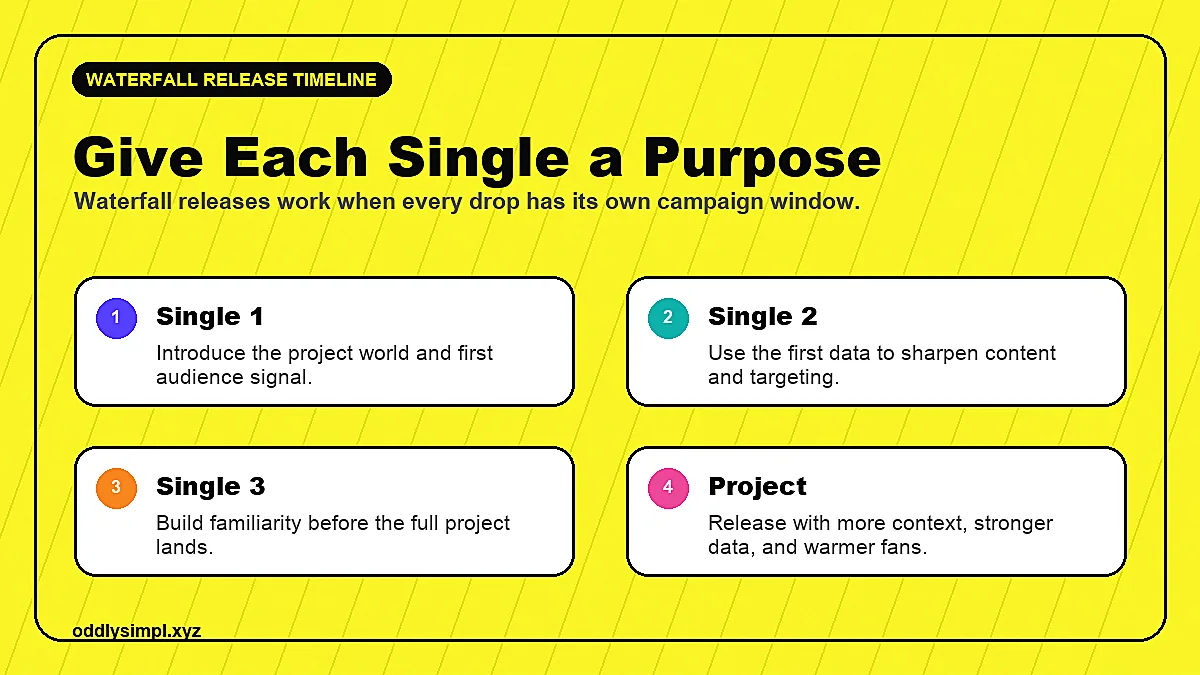
- Week 0: announce the project world, visuals, and first single story.
- Week 2: release Single 1 and test content/ad angles.
- Week 6: release Single 2, retarget engaged listeners, and pitch with updated momentum.
- Week 10: release Single 3 with stronger audience data and fan proof.
- Week 14: release the full EP/album with the previous singles carrying social proof.
Use those dates as a starting point, not a rule. The right waterfall release date depends on your content capacity, distributor deadlines, Spotify pitch timing, and whether the last single gave you enough data to improve the next one.
How to Set Up a Waterfall Release on DistroKid
DistroKid's current waterfall guide describes separate uploads. It does not let you gradually add tracks to an already-delivered album page.
- Upload each single as its own release and record the ISRC assigned to each recording.
- When you upload the full project, include those recordings and enter their existing ISRCs where the upload form supports it.
- Alternatively, upload the future-dated album first, then use its assigned ISRCs for separate single uploads with earlier dates.
- Review the audio, artist names, track titles, versions, and release dates before delivery.
Check your plan's current ISRC options before committing to the schedule. Reusing the right code helps identify a recording; it does not guarantee that every service will preserve every count or playlist placement. See DistroKid's single-to-album guidance for that limitation.
How to Set Up a Waterfall Release on TuneCore
TuneCore has a different workflow. Its waterfall instructions say to begin an album upload, then use Add Existing Track in the Tracks section. Choose an eligible track, complete missing information, and save.
The picker lists approved tracks that are still live. Drafted, denied, or removed tracks aren't eligible for that picker, and the button is not available on single uploads. Reused tracks keep their audio and ISRC locked; contact TuneCore support if those need changing.
These distributor instructions were checked November 14, 2026. Open the linked guidance again when you upload, since interfaces and plan features can change.
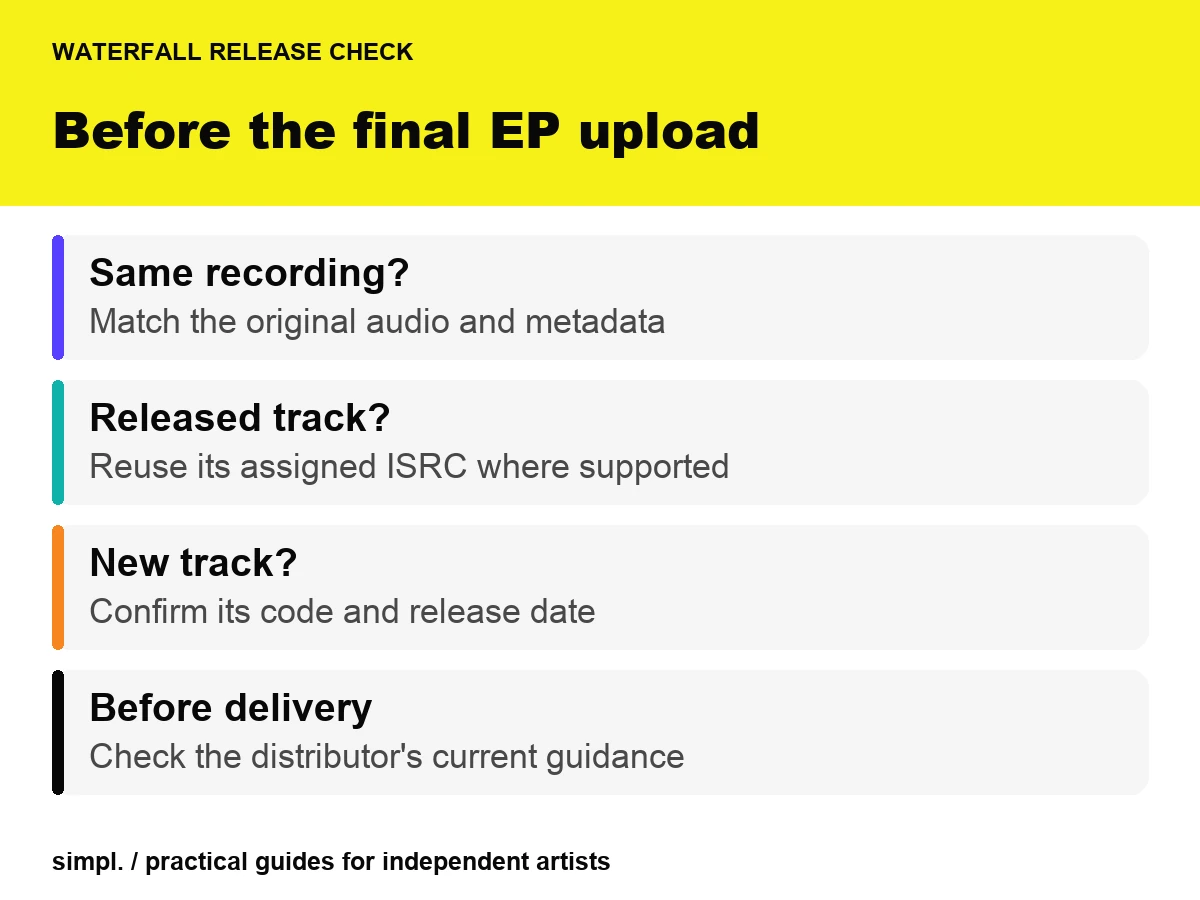
Keep One Release Tracker
Use one row per track. Keep the smart link and pitch deadline next to the delivery details so you aren't rebuilding the plan between singles.
| Track | Audio/version | ISRC | Release date | Pitch deadline | Final project |
|---|---|---|---|---|---|
| [Single 1] | [Exact master] | [Assigned code] | [Date] | [Date before release] | [Track number] |
| [Single 2] | [Exact master] | [Assigned code] | [Date] | [Date before release] | [Track number] |
The upload plan protects the recording details. The campaign plan still needs a different story, content, and measurement window for each song. Set up pre-save campaigns and music analytics before the first release.
Common Waterfall Release Mistakes
- Releasing too fast: if the next song drops before you learned anything from the last one, the sequence is too tight.
- Using the same content angle every time: each song needs a different emotional doorway.
- Forgetting the final project: the album or EP still needs its own reason to matter.
- Overrating pre-saves: pre-saves can help warm fans remember, but they are not the strategy.
- Skipping measurement: a waterfall only compounds if you use the data between releases.
Waterfall Release Strategy FAQ
What is the waterfall release strategy?
A waterfall release strategy rolls out songs in stages, carrying earlier singles into later releases before the full EP or album. For example: one track, then a two-track single containing the new song and the first song.
Why do waterfall releases work for independent artists?
Waterfall releases work because each single gets its own release moment, Spotify pitch opportunity, content plan, smart link, email or social push, ad test, and data review before the next song drops.
How far apart should waterfall singles be released?
For most independent artists, 4-6 weeks between singles gives enough time to pitch, tease, release, analyze, and adjust before the next drop.
Can you do a waterfall release on DistroKid or TuneCore?
Yes, but the exact setup depends on your distributor. Keep the audio, metadata, ISRCs, artwork, and release sequence clean so each single can roll into the final EP or album without splitting play counts or confusing listeners.
Build the full campaign with the music release strategy guide, map tasks with the music release planner, and use simpl's release campaign team when you need ads, smart links, and reporting tied together across every single.
Keep building the strategy
-
Music release strategy
Fit waterfall singles into the full pre-release and post-release system.
-
Music release planner
Map each single, asset, pitch, and content push before you start.
-
Release campaign help
Use ads, content, and analytics to keep the rollout compounding.
About the author

Anthony Pacheco
Anthony Pacheco is the founder of simpl., a former Sony Music analyst, and a Billboard-charting musician who has helped run 750+ artist marketing campaigns. He writes about real listener behavior, release systems, Spotify ads, and how artists can grow without fake playlist traffic.